01
October 9, 2026
Security, privacy, suppliers: why NIST brings three plans around one system
NIST SP 800-18 Rev. 2 connects system security, privacy and supply chain risk plans. How can teams maintain consistent boundaries and reference data?
01 SECTION / CYBERCORIA
Understand an information system through its objects, flows and, above all, its dependencies.
ANSSI methods, architecture, inventories, dependencies, repository governance and cybersecurity use cases.
A useful map is not a collection of diagrams. It is a living repository connecting business activities, applications, data, infrastructure, third parties and risks.
01 / Information system mapping
Inventory is the starting point, but value appears when objects are connected: a business activity depends on an application, and that application depends on identities, data, infrastructure and sometimes third parties. This structure makes impact explainable and produces views that can be reproduced rather than merely illustrated.
02 / Information system mapping
A map built for an audit, disaster recovery or architecture review does not require exactly the same granularity. Cybercoria favours an incremental approach: define the questions, select the necessary objects, document relationships, then organise how the repository will stay current.
03 / Information system mapping
A strong map helps teams find critical components, owners, flows and dependencies without reconstructing the environment during every incident. Articles in this section therefore distinguish inventory, relationships, views and data governance.
7 publications
NIST SP 800-18 Rev. 2 connects system security, privacy and supply chain risk plans. How can teams maintain consistent boundaries and reference data?
Applications and workloads also use identities, tokens and trust relationships. Mapping them reveals access paths that an inventory of human accounts cannot show.
NIST’s new CSWP 36G draft tests six false-base-station scenarios and highlights a dependency enterprises rarely map: access infrastructure they do not own.
ANSSI’s DGFiP incident report shows how compromised identities, reachable systems and incomplete monitoring can form one attack chain.
Building management, cooling, physical access control and maintenance can directly condition IT availability. Useful system boundaries can extend beyond traditional IT.
After an Active Directory compromise, restoring applications is not enough: trust must be rebuilt. Mapping identity and administration dependencies helps determine the real recovery order.
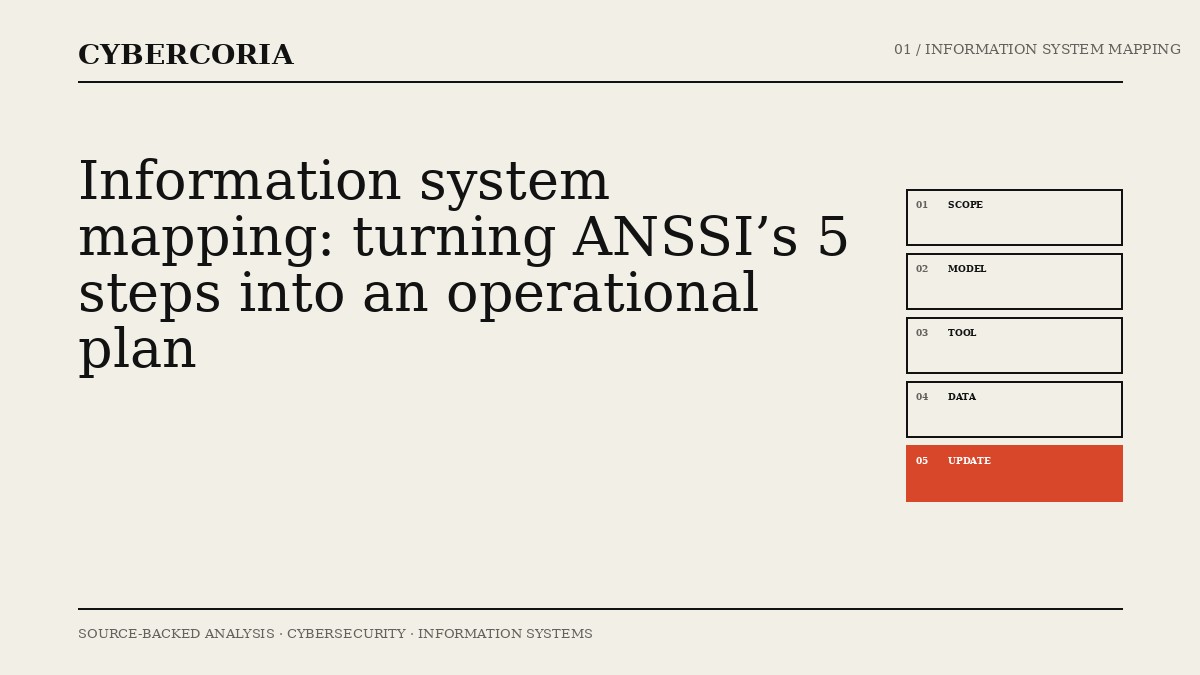
ANSSI proposes a pragmatic, incremental and sustainable approach to information system mapping. Here is how to turn it into a concrete working plan.
A page is published only when it contributes information, a method, a synthesis or a verifiable angle that justifies its existence beyond a search-ranking objective.